

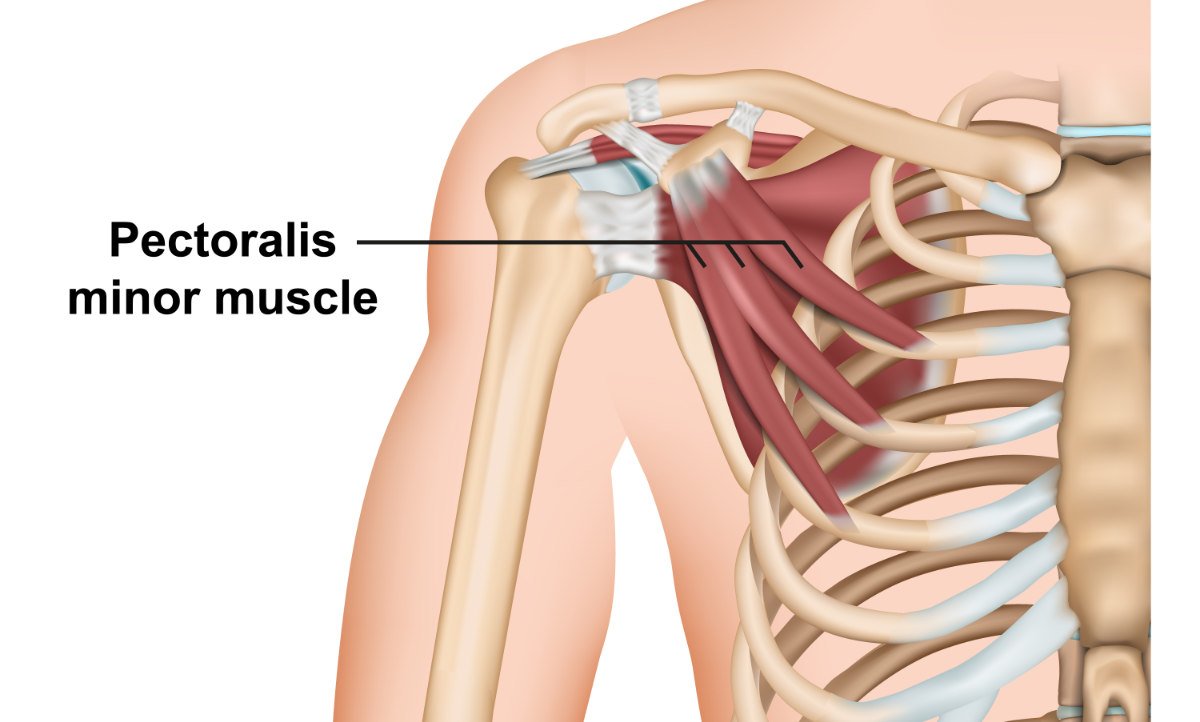
The pectoralis minor muscle is a small pair of muscles with some important functions. Although they don’t get nearly as much press, or attention at the gym, as their larger cousins the pectoralis major muscles, they are just as relevant to everyday functional movements. In this article, we’ll take a closer look at where the pectoralis minor muscle is located and what actions it’s involved in. Read on to learn more.
Quick facts
Origin · Insertion · Action
- Origin
Third, fourth, and fifth ribs (some people have a band to the second rib)
- Insertion
Coracoid process of the scapula
- Action
Scapula free: protraction of the scapula, depression of the scapula, downward rotation of the scapula, stabilizes the scapula to the torso
Scapula fixed: assists forced inspiration
Location
The pectoralis minor is a deep shoulder muscle. You’ll find it in the upper anterior region of the torso, where our shoulder meets our ribcage. It’s deep to (underneath) the larger pectoralis major muscle. Like our other shoulder muscles, we have a pair of these little muscles, one on the right and one on the left.
Specifically, the pectoralis minor attaches at its superior end to the coracoid process of the scapula. This is the small beak-like projection where our scapula reaches all the way to the front of our body. This muscle then travels in typically three bands of fibers to attach at its inferior end to the third, fourth, and fifth ribs. However, anatomists have observed anatomical variation in this muscle and found that some people have a band of fiber that attaches to the second rib. In rare cases, anatomists have observed this muscle attached to the first or sixth rib.
One important point to note about pectoralis minor’s location is that it travels over the top of the brachial plexus. This is a bundle of nerves that come out from the lower cervical vertebrae. The brachial plexus includes multiple nerve branches that become the median, ulnar, and other nerves that supply the shoulder and arm.
Pectoralis minor muscle actions
The pectoralis minor is a significant muscle for movement, stabilization, and even breathing. It makes an important connection between the scapula and the ribcage. In movement, when the scapula is free to move, the pectoralis minor muscle moves the scapula toward its inferior attachment on the third, fourth, and fifth ribs. Pectoralis minor is a small muscle, however, and can assist with different movements depending on which agonists it’s working with.
Pectoralis minor can assist with protraction of the scapula and depression of the scapula. Depending on the position of the arm and torso, pectoralis minor can also assist with downward rotation of the scapula and help stabilize the scapula to the torso.
When the scapula is fixed and not free to move, the pectoralis minor muscle can assist with the action of respiration. Specifically, it can assist with forced inspiration by contributing to lifting and expanding the ribs that it is attached to.
Posture and the pectoralis minor
A short pectoralis minor can create significant resistance to allowing the scapula to return to and rest in a neutral position. Because the pectoralis minor contributes to moving the scapula, and the glenoid fossa of the shoulder (the socket of the shoulder joint) is a depression in the scapula, this small muscle affects shoulder position. It’s related to the shoulder position we so often see, that is, shoulders habitually pulled down and in medially.
Other considerations
As I described above, the pectoralis minor runs over the brachial plexus, which includes the nerves that feed the shoulder and arm. A short, tight pectoralis minor can compress the neurovasculature and cause a variety of nerve, artery, and/or vein-related compression symptoms, depending on which structures are compressed. The axillary region in the body includes a complex intersection of many structures that can impact the brachial plexus, but a short, tight pectoralis minor is one structure that can contribute to nerve-compression symptoms.
Conclusion
The pectoralis minor is a small but significant muscle on the upper anterior portion of our chest. It’s a deep muscle that contributes to balanced shoulder and arm position. In situations of particularly strong inhales, it can even assist with respiration.
The course
Learn all 65 muscles the way you just learned this one.
12 modules · 79 lessons · 11 quizzes · 30-day guarantee.
References
Chaitow, L. and J. DeLany. 2011. Chapter 13: Shoulder, Arm, and Hand. In Clinical Application of Neuromuscular Techniques. Volume 1 (Second Edition). New York, NY: Churchill Livingstone Publishing.
Gilroy, A.M., B.R. MacPherson, and J.C. Wikenheiser (Eds.) 2025. Atlas of Anatomy. (5th ed.) Thieme.


